
Your Body Remembers Trauma. What If It Could Remember Safety Again?
"For the first time in years, I felt like my body finally realized the danger was over."
It's a sentiment we hear often from people after receiving a Stellate Ganglion Block (SGB).
Not because the treatment erased what happened.
Not because it made trauma disappear.
But because, for many people, it quieted the body's constant alarm system enough to let healing begin.
PTSD is more than memories. It can change the body's biology, leaving the nervous system trapped in survival mode long after the danger has passed. Researchers now understand that trauma affects both the mind and the body, opening the door to new approaches that address the nervous system itself.
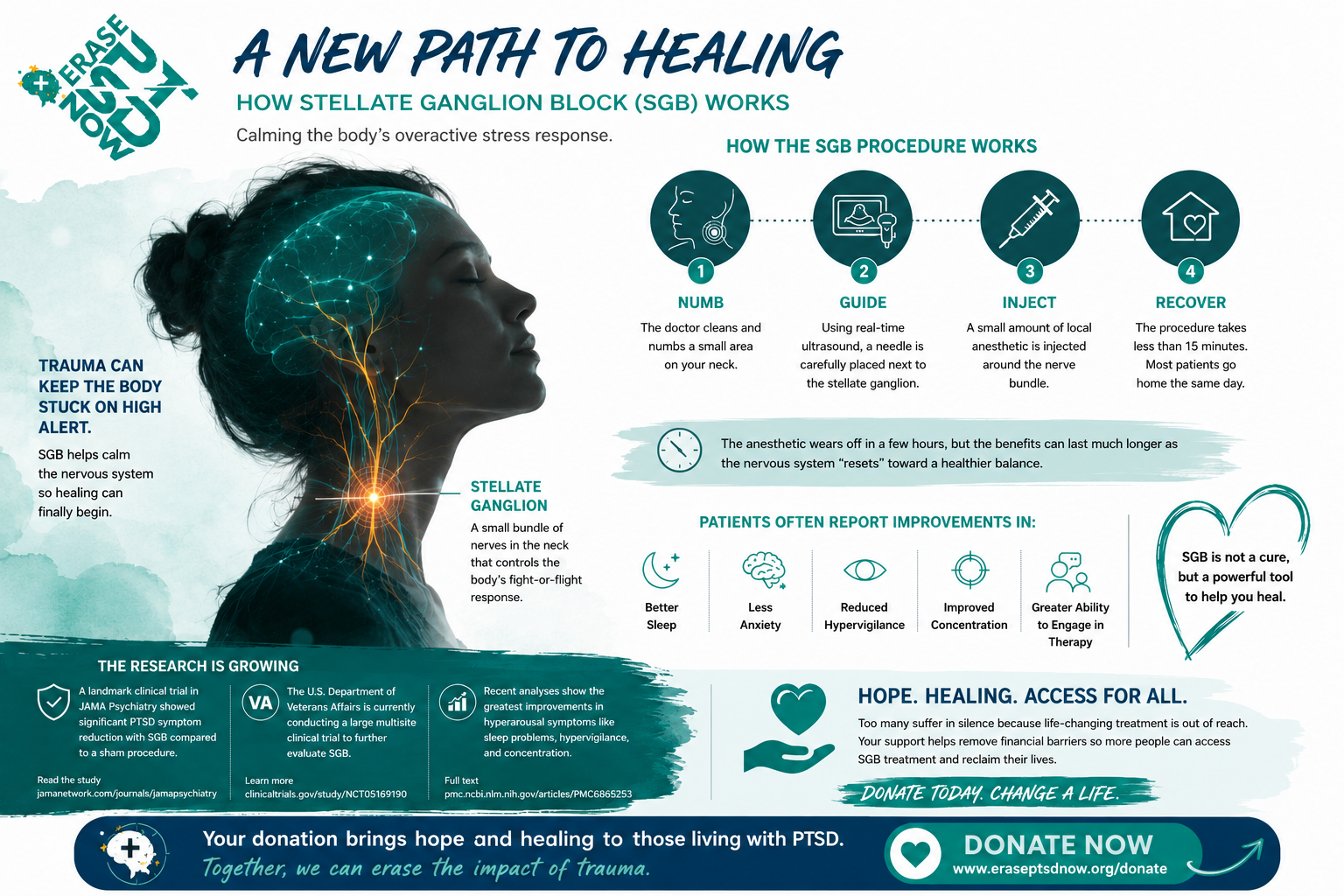
The stellate ganglion is a small bundle of sympathetic nerves located on each side of the lower neck. These nerves help regulate the body's fight-or-flight response.
After trauma, that system can become overactive, continuing to send danger signals even when life is safe. The result can include:
Hypervigilance
Anxiety
Sleep disturbances
Difficulty concentrating
Irritability
Feeling constantly "on edge"
This isn't a lack of willpower.
It's a nervous system that hasn't been able to return to balance.
A Stellate Ganglion Block (SGB) is a minimally invasive medical procedure that has been safely used for decades to treat certain pain and circulatory conditions. Researchers later discovered it may also help reduce PTSD symptoms by calming the body's overactive stress response.
The procedure typically takes less than 15 minutes.
Using real-time ultrasound guidance, a physician carefully places a needle next to the stellate ganglion and injects a small amount of local anesthetic around the nerve bundle. Most patients return home shortly afterward.
Although the anesthetic wears off within a few hours, researchers believe temporarily interrupting these overactive nerve signals may allow the nervous system to reset toward a healthier balance.
Many patients report improvements in:
Sleep
Anxiety
Hypervigilance
Concentration
Emotional regulation
Their ability to engage more fully in therapy
The evidence supporting SGB continues to grow.
A landmark randomized, sham-controlled clinical trial published in JAMA Psychiatry found that active-duty service members who received two SGB procedures experienced significantly greater reductions in PTSD symptoms than those receiving a sham procedure.
The U.S. Department of Veterans Affairs is currently conducting a large multisite clinical trial to further evaluate the effectiveness, durability, and safety of SGB in Veterans living with PTSD.
Researchers have also found the greatest improvements in symptoms related to hyperarousal, including hypervigilance, sleep disturbances, and difficulty concentrating—symptoms that many people with PTSD describe as the most disruptive to daily life.
SGB is not a cure for PTSD, and it does not erase traumatic memories.
Instead, it may help quiet the body's persistent alarm response, allowing many people to sleep better, think more clearly, reconnect with loved ones, and participate more effectively in therapy.
Recovery isn't about forgetting what happened. It's about giving your body the opportunity to remember what safety feels like again.
Hope Should Never Depend on Your Bank Account. At Erase PTSD Now, we believe financial barriers should never prevent someone from accessing innovative treatment.
Since October 2020, we've helped provide access to more than 1,900 SGB procedures, supporting over 1,400 individuals on their journey toward healing.
Behind every procedure is a person. A parent reconnecting with their children. A Veteran sleeping through the night. A survivor finding hope after years of living in survival mode.
Every donation helps another person take that first step toward healing. Help Someone Begin Healing Every day, people remain on our waiting list because they cannot afford treatment. Your gift can help someone move from surviving to healing.
Medical Disclaimer: This article is for educational purposes only and should not be considered medical advice. Erase PTSD Now does not diagnose or provide medical treatment. All treatment decisions, including the use of Stellate Ganglion Block (SGB), patient eligibility, and follow-up care, are determined solely by licensed healthcare providers based on each individual's medical history and clinical evaluation. If you believe you may be experiencing PTSD or another medical condition, please consult a qualified healthcare professional.